Dry type transformers are valued for safer indoor installation, reduced fire risk, and simpler maintenance. Yet their solid insulation and air-based heat transfer can limit thermal performance. This raises an important engineering question: why do dry type transformers require forced air cooling? Under heavy loads, copper losses and core losses create heat inside windings, especially around blocked ventilation paths and tightly packed coils. Natural air circulation may not remove that heat quickly enough.
IEC 60076-11 establishes temperature-rise requirements for dry type transformers, while IEEE C57.96 provides guidance for loading and thermal behavior. The U.S. Department of Energy’s distribution transformer analysis also evaluates load losses, no-load losses, and efficiency impacts across operating conditions. These professional references show why cooling decisions must consider more than rated capacity. Site altitude, ambient temperature, harmonics, enclosure design, and daily load cycles all matter.
Transformer specialist Martin Heathcote offers a practical warning: “Temperature rise is the limiting factor in transformer design.” That principle explains the common AN/AF ratings, where fans increase airflow across hot windings and improve short-term overload capability. However, forced air is not a universal cure. Fans add noise, maintenance points, and possible failure modes. A fan can also hide an undersized design. The answer is not always simple.
This guide examines five technical reasons forced air cooling becomes necessary, using field experience, engineering standards, and published industry analysis. It also considers when natural cooling remains sufficient, because overcooling wastes energy and complicates maintenance.
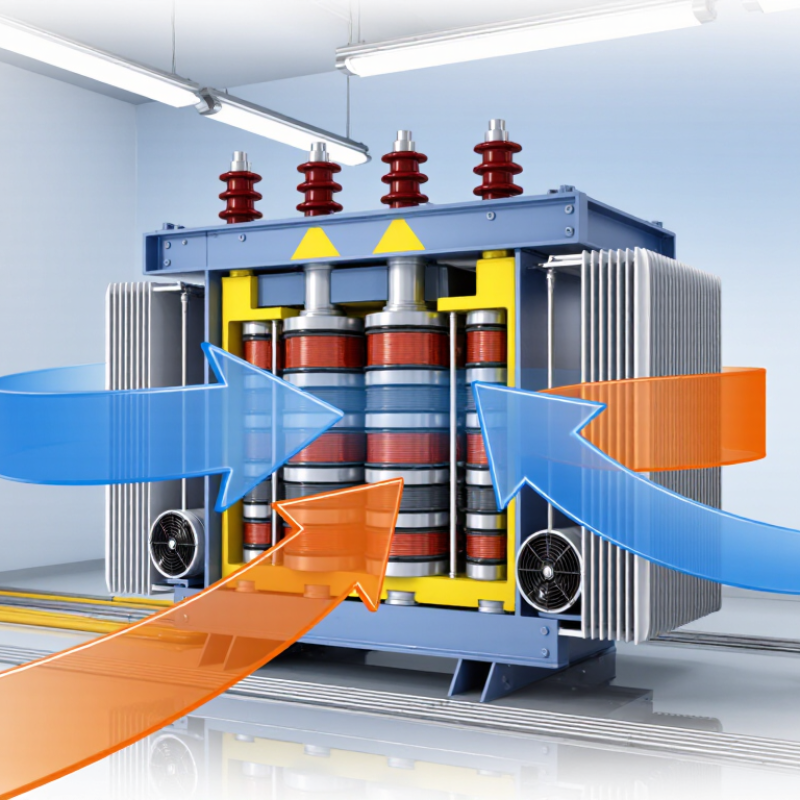
At a 40°C ambient, a dry-type transformer starts with less cooling margin. Its windings may already be warm before the load increases. Natural-air cooling depends on buoyancy, so hot air rises slowly through the enclosure. The result can be higher winding temperatures during peak demand. Small airflow changes matter.
Forced air cooling adds controlled airflow across the windings and cooling channels. This can reduce hot-spot temperature and support higher short-term loading, when the design permits it. It also helps equipment manage heat in compact rooms, high-load facilities, and poorly ventilated enclosures. But fans do not create unlimited capacity. Check the manufacturer’s temperature-rise and loading data.
Keep five practical points in view: monitor ambient temperature, inspect fan operation, clean blocked air paths, verify alarm settings, and record thermal images during heavy loading. A failed fan can quickly remove the expected cooling benefit. That risk is easy to underestimate. Dust, noise, vibration, and fan redundancy also deserve attention. In field inspections, technicians should compare measured temperatures with design limits, not rely on cabinet touch alone. I have seen acceptable average readings hide warmer connection points. This is why maintenance records and operating trends remain important, even when the transformer appears to run normally.
5 Tips Why Dry Type Transformers Need Forced Air Cooling?
How Forced Air Reduces Hot-Spot Risk Within 80–150 K Temperature-Rise Classes
Dry type transformers may operate within 80–150 K temperature-rise classes, but internal hot spots can still develop. The rating describes average winding temperature rise, not every conductor’s hottest point. Forced air moves heat away from coils, ducts, and core surfaces. This reduces thermal concentration during high loads. The numbers matter.
Keep airflow paths clear around the enclosure. Dust, blocked grilles, or misplaced cables can weaken cooling performance. Fans should start through temperature sensors or a reliable control sequence. A fan running continuously may waste energy and create unnecessary noise. It is not always better.
Monitor winding temperature, ambient temperature, and fan operation together. A 120 K rise in a clean room may behave differently from the same rise in a dusty, poorly ventilated space. Regular inspections should check bearings, filters, terminals, and unusual vibration. Small details matter. Designers should also confirm that airflow reaches the hottest coil sections, rather than only cooling the enclosure surface.
Forced air can provide short-term overload support, but it cannot repair poor transformer sizing. It also cannot compensate for excessive ambient heat or blocked ventilation. This is where practice becomes less perfect: temperature sensors may lag behind rapid load changes, and maintenance schedules are sometimes too optimistic. Conservative settings, tested alarms, and recorded thermal trends offer a safer margin within 80–150 K classes.
AN/AF means air natural and air forced. In AN mode, ventilation relies on convection through the enclosure. When fans start, airflow moves directly across windings and core surfaces. Many manufacturers therefore rate an AF transformer at approximately 1.33 times its AN capacity. The figure is common, not universal. Actual performance depends on temperature rise, enclosure design, altitude, and ambient temperature.
For example, a 1,000 kVA dry-type transformer may reach about 1,330 kVA with approved forced-air operation. The extra output does not come from stronger copper. It comes from removing heat faster. Lower winding hot-spot temperatures can protect insulation and reduce thermal ageing. IEEE C57.96 identifies cooling method, ambient temperature, and temperature rise as key loading factors. IEC 60076-11 also classifies dry-type transformer insulation and thermal performance requirements.
Fans need careful control. Poor airflow, blocked filters, or incorrect fan sequencing can erase the expected gain. Dust can collect between cooling channels. That detail is often underestimated. CIGRE transformer loading guidance also emphasizes hot-spot temperature and site conditions rather than relying on nameplate capacity alone. A 33% increase should therefore be verified through factory data, thermal calculations, and commissioning tests. Bigger capacity is useful, but only when the cooling path remains dependable.
Forced air cooling is not merely a way to make dry type transformers quieter or smaller. It changes how heat leaves the windings, core, and enclosure. Five practical controls matter: clean airflow, correct fan capacity, reliable temperature sensors, staged operation, and scheduled inspection.
Copper losses rise with load current squared. A small overload can therefore create a sharp temperature increase in the windings. Fans reduce winding hot spots by moving air across ducts and coil surfaces. Core losses remain largely constant at rated voltage, but they still become heat. IEC 60076-11 requires dry type transformers to meet thermal performance and insulation requirements under defined conditions. IEEE C57.12.01 also recognizes temperature-rise limits up to 150°C for some 220-class insulation systems. These figures leave little room for blocked filters or failed fans.
Insulation aging is the quieter risk. Thermal-aging models in IEC loading guidance commonly treat each 6–8°C increase as roughly doubling aging speed, depending on the insulation system. That is not a universal rule. Site conditions matter. Dust, altitude, humidity, and repeated fan cycling can change the result. The U.S. Department of Energy’s transformer efficiency analysis also shows that even modest loss reductions can save substantial electricity across large installed fleets. Fan control should begin before temperatures peak, not after an alarm. Yet oversized fans may waste power and accelerate dust entry. A better design uses staged cooling, verified airflow, and recorded temperature trends. One missed inspection can undo the calculation.
IEEE C57.12.01 defines dry-type transformer temperature limits and cooling requirements. Common temperature-rise ratings include 80°C, 115°C, and 150°C. These values depend on insulation systems and design conditions. Forced air removes heat from windings and cores. It helps keep operating temperatures within specified limits.
IEEE assumptions often include a 40°C maximum ambient temperature. However, crowded electrical rooms can become hotter. Dusty filters, blocked louvers, and weak airflow can quickly reduce cooling performance. A spreadsheet may look safe. A dusty grille can disagree. U.S. Department of Energy technical analyses identify transformers as significant electricity users, with losses reaching roughly 2% of national electricity consumption. Better cooling can support efficiency and service life.
An AF rating does not mean unlimited loading. Fans, sensors, alarms, and automatic controls must operate correctly. Field inspections should verify airflow direction, fan rotation, and winding temperature readings. I would not treat extra kVA as a free upgrade. IEEE C57.12.01 data, manufacturer test reports, and site measurements should be reviewed together. Temperature imbalance between phases also deserves attention, especially during peak loading.
Fans move air across windings, core surfaces, and internal ducts. This reduces hot spots during heavy loading. Heat still remains.
Copper losses increase with the square of load current. A small overload can cause a sharp winding temperature rise. That change can happen quickly.
Fans do not remove core losses themselves. They help carry the resulting heat away from the core and enclosure. Core heating still matters.
Cooling should begin before temperatures reach alarm levels. Temperature sensors and staged controls can activate fans gradually. Late action is risky.
No. An airflow rating does not create unlimited capacity. The transformer, insulation, sensors, alarms, and site conditions must support the load. Extra capacity is not free.
High room temperature, blocked louvers, dusty filters, and poor airflow reduce cooling performance. A crowded electrical room may exceed design assumptions. The spreadsheet may be wrong.
Many thermal-aging models estimate faster aging after each 6–8°C temperature increase. This is not universal. Humidity, dust, altitude, and cycling also matter.
They should check fan rotation, airflow direction, filters, sensors, alarms, and temperature readings. Phase temperatures should be compared during peak loading. One missed inspection can undo careful planning.
Dry-type transformers rely on natural-air cooling under normal operating conditions, but this method can reach its practical limit at the 40°C ambient reference used in IEC 60076-11. As load increases, heat generated by copper and core losses raises the winding hot spot, increasing insulation stress and accelerating aging. This explains why do dry type transformers require forced air cooling: fans improve airflow across the windings and core, helping control temperature and reduce thermal risk within common 80–150 K temperature-rise classes.
In AN/AF designs, forced air can commonly increase a transformer’s usable capacity by about 33%, depending on its construction, duty cycle, and environmental conditions. Improved cooling helps manage both load-related copper losses and continuous core losses, while supporting more stable insulation performance. When operating conditions approach the temperature limits specified by IEEE C57.12.01, forced-air operation may be necessary to maintain reliability, preserve service life, and prevent overheating during peak demand.

Pirooz Power